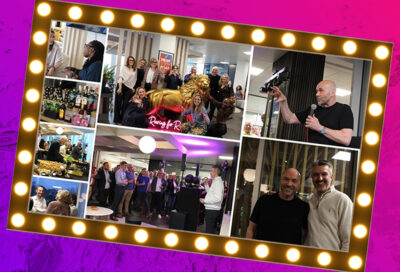


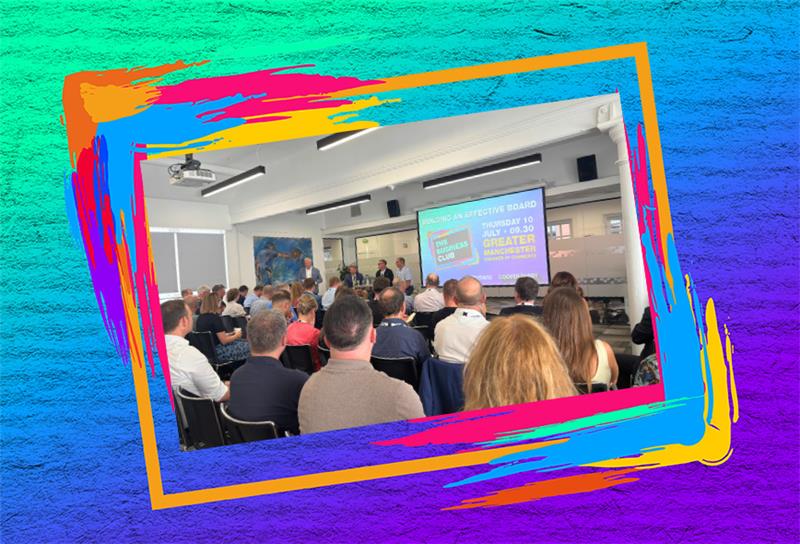
On one of the hottest days of the year, right before the Gallagher brothers made their Heaton Park return, the Greater Manchester Chamber of Commerce was buzzing.
Not just from the whirring of fans, or the stirring chatter from lucky Oasis ticket holders. Instead, the room was alive with the energy of ambitious founders, CEOs and senior leaders, gathered for our latest Manchester Business Club event.
Hosted in collaboration with Bermans, the session tackled a topic that’s often overlooked until it’s too late: how to build an effective Board that drives – rather than delays – business growth.
SETTING THE SCENE
The morning kicked off with David Colgrave, Head of Executive Search at Axon Moore, setting the tone. He framed the session around a key challenge many scaling businesses face: when and how to bring in senior talent and independent oversight to support the next stage of growth.
The panel – made up of David Mitchell (CEO, Traditum), Stuart Watson (Non-Exec Director & Audit Committee Chair), and David Moore (Founder & CEO, Axon Moore) – brought a wealth of experience and candid stories from the frontlines of business leadership.
WHEN IS THE RIGHT TIME TO BUILD A BOARD?
The consensus? Most founders wait too long.
- David Mitchell described the moment as a “conscious realisation” – when a founder recognises they need new ideas and expertise to move forward.
- Stuart Watson reflected on his time with EY’s Entrepreneur of the Year Awards, noting that many founders only realise the need for a Board after they’ve hit a wall.
- David Moore shared a personal story about acquiring a recruitment business without the right financial oversight – a decision he later regretted. “We act reactively too often,” he admitted.
BUILDING A BOARD: WHAT DOES ‘GOOD’ LOOK LIKE?
When planning for growth, the panel agreed that the first hires should be strategic – not just operational.
- David Mitchell emphasised the importance of risk analysis and learning from failure. “Building a Board needs to be measured. It needs to be planned. One of the functions of the Board is to analyse risk. Everyone will fail, but you learn the most from those experiences. Founders often stick to what they know. But when you’re doing something that’s outside of your comfort zone to take the business to the next level, that’s when you need to recruit people with different skillsets and experiences.”
- Stuart Watson advocated for early-stage coaching or mentoring. “You need someone to help you stop the wheels and ask, ‘Are we on the right track?’ Cash can run out very quickly if you’re not keeping an eye on it. And if you’re a finance-orientated, number-crunching person, you’re probably missing opportunities in the market. So, it’s about diversity of skillsets.”
- David Moore agreed with Stuart and warned against being dazzled by CVs. “It’s about chemistry, character, calibre and trust – not just credentials.”
This theme of trust was touched on repeatedly by all our speakers. It’s an essential building block in the journey towards creating an effective Board, and something that outweighs any previous roles and achievements.
THE IMPORTANCE OF INDEPENDENT OVERSIGHT
The discussion turned to non-executive directors (NEDs). Particularly, when to bring them in, and how to get it right.
- Stuart Watson was forthright in his take: “When you reach a certain level of complexity, the right non-exec is a useful independent viewpoint. You need someone who’s been to lots of places, learnt lots of things, is independent and has no axe to grind. If you get the wrong one, they turn into an interfering so and so. Get rid of them fast.”
- David Mitchell added, “A NED shouldn’t try to fix your problems – they should offer independent perspective.”
- David Moore cautioned against hiring based on reputation alone. “You need someone who’s ready for the challenge – and someone who knows you’re still the boss.”
The panel agreed that independent Chairs play a crucial role in succession planning and maintaining objectivity – especially when founders are emotionally tied to the business.
- Stuart Watson shared, “Having a Chair that’s independent of the big boss is important. If there’s a succession issue or a running out of talent issue, the Chair is important in recognising that because we may not recognise it in ourselves when we’ve got our heads down in the day to day. Independent oversight and tapping into the Chair as an organiser of the succession planning piece is deeply important.”
- David Mitchell continued, “No business owner or Chair stays in the same place forever, and if it’s your business, you think you can. If you’ve got any sense, a few years out, you should be thinking about recruiting the next in line.”
- David Colgrave then told a story of a client who left their succession planning way too late. “They were physically and emotionally tied to the business, and they said, ‘I should have been thinking about this 10 years ago. I love my business but have I added any value to it over the last few years? Probably not. I should have brought in someone with more energy and new ideas to help me do that.’”
It was a stark reminder that founders don’t stay in the same place forever – and that planning for the future is a sign of strength, not weakness.
BOARD DYNAMICS: WHAT MAKES A GREAT MEETING?
According to Stuart Watson, the best Board meetings are built on trust, preparation and focus. “You need enough facts and figures to make decisions, a culture where people can speak openly and monthly check-ins to make sure you’re on track, with discussions around big decisions like key hires, investments etc.”
The worst? “They have too many people there – and too many people with an axe to grind.”
AUDIENCE Q&A: REAL CHALLENGES. REAL ADVICE
To conclude the session, our audience asked a number of questions that sparked deeper discussion:
- How do you measure if your Board is working?
David Mitchell suggested reviewing roles and skillsets against business goals. “There’s nothing more powerful than cognitive diversity in a Board,” he said. “I would take a look at all the different roles and skillsets on the Board and find out whether they’re delivering towards what you’re trying to achieve as a business. I’ve got it wrong where I’ve recruited somebody, thinking they were going to be brilliant because of their reputation – and that’s how I learnt. Accept that failure is a part of growth.”
“We’ve all hired the wrong people,” Stuart Watson added. “But the danger is the familiarity aspect. If you’ve been working with someone for years and years, you can be blind to the fact that they’re no longer the right person. The ability to stand back and look at your business and Board when you’re growing at a hundred miles an hour is so important.”
- What about fractional leaders? How well do they work in a bootstrapped business?
David Moore was cautious on this topic. “With a full-time FD, for example, you get all that expertise and more. There are people who do fractional work that can give you a lot, but it’s about deciding what the best fit is for you. I’ve got a slight reticence to it.”
“Historically, fractional leaders used to be people coming to the end of their careers,” David Colgrave added. “People are now considering these roles much earlier in their career. There are good quality fractional specialists out there, but what are they going to do for you? What are their deliverables? Beyond whether they’re fractional or full-time, these are the key questions to ask.”
- How do you onboard a new Board member effectively?
“Getting them enough under the skin of the business to understand what’s going on is key,” Stuart Watson said. “You’ve got to have a strong working relationship with the exec.”
David Mitchell continued: “The trust and qualitative side is really important. I work with a lot of family businesses and the onboarding is different there, but the focus remains on principles of objectivity and understanding the business and what runs through it. If I’m recruiting a non-exec or anybody for that matter, they need to be able to understand how we’re operating and the goals of the business.”
BOARDS AS GROWTH ENGINES
The July 2025 Manchester Business Club event made one thing clear: a well-structured Board isn’t a luxury – it’s a necessity for any business serious about scaling.
Whether it’s bringing in a mentor, hiring a Chair, or formalising governance structures, the right moves at the right time can unlock new levels of performance, accountability and innovation.
As David Moore put it, “It’s not about ticking boxes. It’s about building something that helps you grow – and keeps you growing.”
If you missed this one, don’t worry – we’ll be back soon. And if you were there, thank you for making it such a memorable morning.