



The widely anticipated SpaceX Initial Public Offering (IPO) is expected to be the largest in history. Yet despite the inevitable headlines and excitement, its initial impact on diversified investment portfolios may be far smaller than many investors expect.
An IPO marks the point at which a company decides to go public by listing its shares on a stock exchange, allowing investors to become part owners of the business. The upcoming SpaceX IPO has attracted significant attention and is expected to make SpaceX the largest company ever to list on the stock market. Anthropic Labs and OpenAI are also expected to follow later this year.
LIFT-OFF DOESN’T NECESSARILY MEAN OWNERSHIP
A large IPO may appear immediately significant, but its actual impact on investment portfolios depends on several factors, including:
- How much of the company is available for public trading (the “free float”)
- The eligibility requirements of index providers
- How fund managers approach IPOs
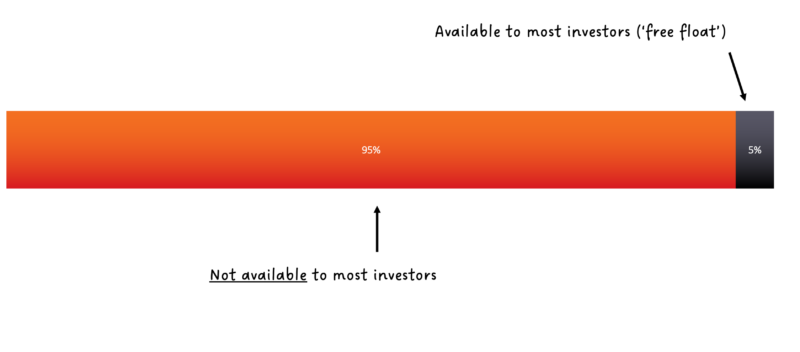
Even very large companies may initially make only a small proportion of their shares available to public investors. This means the amount available to buy at the point of listing can be relatively limited. SpaceX is expected to float only around 5% of its total shares.
Some companies list the majority of their shares, meaning ownership is largely public. Microsoft is one such example. Others choose to list only a small proportion, with the remainder retained by founders, employees or other stakeholders.
Figure 1: Illustration of free float shares compared to total outstanding shares (5% float)
Source: Albion Strategic Consulting
GRAVITY MATTERS: WHY INDEX RULES KEEP WEIGHTINGS GROUNDED
Understanding free float is important because most market indices – and the funds that track them – weight companies based on their free float-adjusted market capitalisation.
As a result, a very large and valuable company with a relatively small free float may carry a much smaller weighting within an index. Consequently, its representation in diversified portfolios can also be materially smaller than many investors might assume.
A good example is Saudi Aramco. When it floated less than 2% of its shares in 2019, it became the largest listed company in the world by valuation. However, because only a small proportion of shares were publicly available, relatively few investors saw the company appear among the largest holdings in their portfolios.
This position can change over time. IPOs often include “lock-up” provisions, which prevent existing shareholders from selling their shares for a defined period following the listing. As these restrictions expire, additional shares may come to market, increasing the free float and potentially boosting the company’s weight within indices and portfolios.
Index inclusion is not always immediate, nor is it guaranteed. Major index providers apply specific criteria that determine both eligibility and timing. In some cases, very large companies may be fast-tracked into indices, but their weighting is still typically determined by free float, limiting their initial portfolio impact.
Fund managers may also take different approaches. The systematic fund managers we use within our portfolios are not forced buyers at IPOs. In practice, some strategies deliberately delay investment, reflecting the view that price discovery can be less reliable in the period immediately following a listing.
WHAT COULD THIS MEAN FOR YOUR PORTFOLIO?
Even with its enormous valuation, SpaceX’s estimated index weighting would place it well below today’s largest holdings in a typical market index fund.
Figure 2: Percentage allocation of the top 10 holdings in a market index fund compared with the expected initial free float weighting of SpaceX

Source: Albion Strategic Consulting. For illustrative purposes only. SpaceX approximation based on an expected initial free float weight of around 0.1%. Several sources estimate the initial listing value at approximately $75bn, while the US stock market is currently valued at more than $75tn.
Within your portfolio, the starting point is the belief that market prices incorporate available information quickly enough that persistent pricing inefficiencies are difficult to identify and exploit. Few professional investors can consistently do so.
Tilting towards well-documented risk factors such as value and smaller companies – as we do – typically results in IPO exposure that differs from a pure market-cap weighted index. These allocations will evolve over time as companies develop and their characteristics change. Ultimately, the stock market – reflecting the collective judgement of millions of investors – rapidly incorporates new information into prices.
MORE SLOW BURN THAN SUPERNOVA
While the SpaceX, Anthropic and OpenAI IPOs are likely to dominate headlines, their initial impact on our diversified portfolios is expected to be modest.
Over time, as additional shares become available and index weightings adjust, their influence may increase. However, this is more likely to be a gradual evolution than an immediate transformation.
MISSION CONTROL
Our Investment Committee will continue to monitor developments closely before, during and after these listings.
In the meantime, if you would like to discuss any aspect of your portfolio or how these IPOs may affect your investments, please speak to your Relationship Manager or contact our team today.
Past performance is no guarantee of future returns and the value of investments and the income from them are not guaranteed and can fall as well as rise. The returns from your portfolio will fluctuate over time. On encashment of your investment, you may not get back the full amount invested and could lose part or all of your capital. This communication is for general information only and is not intended to be individual advice. You are recommended to seek competent professional advice before taking any action.