



Artificial intelligence is racing through the tech and high‑growth landscape, reshaping how companies operate and how finance teams deliver value. But while the hype is everywhere, the results often aren’t.
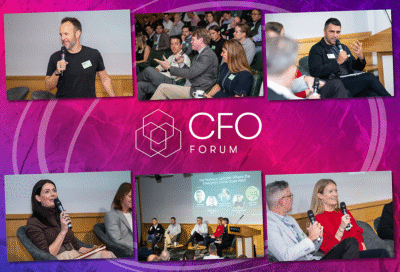
As part of our ongoing look at discussions from CFO Forum hosted by Cooper Parry and Founders Forum, we’re spotlighting key themes from a conversation between Steve Leith, Head of Tech & High Growth at Cooper Parry and Daniel Kim, CFO at Synthesia. Their discussion explored how AI is beginning to redefine the finance function, particularly in high‑growth, tech‑driven organisations where speed, clarity and scalability matter most.
Synthesia, a business building an entirely new enterprise category, offers a glimpse into how finance can operate when it’s designed from first principles rather than inherited systems and structures. And for CFOs in tech and high‑growth businesses, the opportunity is bigger than a productivity boost. This is a moment to rethink operating models, team design, data architecture, and the very purpose of finance itself.
AI as a Structural Shift, Not a Tactical Add‑On
A key thread running through the discussion was the recognition that AI is following the same pattern as previous technology waves – e‑commerce, cloud, mobile – where hype arrives years before the real architectural transformation. The real shift comes when organisations stop retrofitting AI into outdated workflows and instead rebuild those workflows so that AI can drive meaningful impact.
In finance, that change is structural. It requires reconsidering how data flows through the organisation, how processes are owned, and how decisions are made. Rather than viewing AI as something you bolt onto an ERP, leading finance teams are placing AI at the centre of their operating model. Claude’s acceleration in recent weeks has just opened everyone’s eyes just what is possible in-house.
Why Traditional Finance Workflows Are Holding Teams Back
Two major blockers surfaced repeatedly in the discussion, issues that are near-universal across high‑growth companies:
Fragmented, handoff-heavy workflows
Traditional finance structures split responsibilities across AP, AR, FP&A, revenue recognition and operations. This creates slow cycles, inconsistent interpretations and layers of reconciliation. When AI is introduced into this environment, it simply accelerates the inefficiency rather than fixing it.
Data foundations that aren’t AI-ready
AI only works when data is clean, joined, tagged and easily discoverable. Legacy systems and siloed processes rarely meet that bar. Without a governed central data layer, AI outputs become brittle, confidence erodes and adoption stalls.
To get meaningful results, CFOs need to start with workflow design and data architecture, not tooling.
A Modern Finance Architecture for the AI Era
One of the most impactful themes from the conversation was the shift away from ERP‑centric finance. Instead of relying on a monolithic system of record, forward‑thinking teams are building around a data‑warehouse‑first architecture with:
- Clean, governed financial and operational data
- Support for both structured and unstructured (vectorised) content
- Integrated access for foundation models to reason and retrieve
- Strong controls around access, lineage and audit
This becomes the platform for an AI‑enabled operating model. Finance teams then reorganise around end‑to‑end workflows, such as order‑to‑cash and procure‑to‑pay, where a single team owns the entire process. This eliminates ambiguity, strengthens accountability and radically improves cycle times.
Companies like Synthesia are already demonstrating how effective this can be when you design the finance engine from scratch, without legacy drag.
Practical AI Use Cases Already Delivering Value
Several real‑world use cases emerged as high‑impact when supported by the right foundations:
- Revenue Recognition
AI models help interpret contract terms, compare obligations and generate draft memos aligned to IFRS 15 and ASC 606, while finance retains full judgement and sign‑off.
- Forecasting & Narrative Automation
Rather than manually assembling data and writing commentary, AI identifies patterns, builds first‑draft narratives and highlights driver changes. Analysts spend more time analysing and less time preparing.
- Board & Leadership Reporting
AI transforms structured metrics and commentary threads into cohesive, narrative‑ready insights, cutting reporting cycles from weeks to days. Claude is even preparing an entire finance pack with reconciliations, commentaries and financial statements ready for external audit.
- Slack‑Native Finance Q&A
Employees can ask invoice status, compensation queries or policy questions directly within Slack, with responses pulled from governed, real‑time data via secure internal servers. Finance becomes more accessible without becoming reactive.
The unifying theme: humans set the guardrails; AI does the heavy lifting.
A New Talent Mix for the Modern Finance Team
The session also highlighted a shift in hiring and skills. AI‑enabled finance functions increasingly blend:
- Data engineers and analysts embedded directly into finance
- Accountants who think in first principles, not templates
- Generalists who thrive in fast‑changing, unstructured environments
- People with high intellectual curiosity, capable of redesigning workflows rather than just operating them
With automation taking on reconciliation and narrative drafting, many high‑growth companies expect the month‑end close to compress from three days to one or two, with finance teams focusing on exceptions, insight and strategic storytelling.
From System of Record to System of Intelligence
The biggest mental shift is philosophical: the role of finance is expanding. Instead of merely recording what happened, finance is becoming a real-time system of intelligence, interpreting what’s happening, identifying what matters, and predicting what comes next. This evolution is already visible as AI unlocks faster cycles, richer insights and clearer controls.
For the modern finance function, this shift touches every part of the operating model:
- Reporting becomes real‑time, meeting the business at its pace.
- Forecasting becomes continuous, updated dynamically as new data flows in.
- Controls become stronger, thanks to logged prompts, transparent outputs and full audit trails.
- Decision‑making becomes faster and sharper, with insight integrated directly where teams work.
- Finance becomes a strategic engine, shaping decisions, scenarios and growth plans.
With AI taking on the heavy lifting of reconciliation, analysis and narrative generation, finance teams can focus more on strategic thinking, commercial partnering and scenario planning, the work that genuinely drives growth. It’s a shift from hindsight to foresight, from reporting the past to shaping the future.
Final Thought
In many ways, the shift to AI is giving CFOs the chance to redesign finance from the ground up. Not to add more tools, but to build an operating model where intelligence, automation and human judgement work together by default. For high‑growth businesses, this isn’t a distant future – it’s the new competitive edge. The organisations that rethink their data, workflows and team design today will be the ones defining what modern finance looks like tomorrow.
If this shift resonates and you’re exploring how to modernise your finance function, whether that’s redesigning workflows, strengthening reporting, building an AI‑ready data layer, or reviewing your finance systems, we’d love to help.
Across Cooper Parry Digital and our Tech & High Growth team, we partner with scale‑ups and high‑growth businesses to create finance environments built for speed, intelligence and future‑proof scalability.
👉 Get in touch to explore what this could look like for your business